Hojaldres, Tostones, and the Glorious Panamanian Art of Frying Things Right
Let's be honest: Americans love fried food. We love it at state fairs, at fast food counters, and increasingly at high-end restaurants where chefs charge twenty dollars for something that's essentially a really good fritter. So it's a little surprising that Panamanian fried dough traditions haven't broken through in the same way that, say, Korean fried chicken or churros have. Because what Panama is doing with flour, plantains, and a hot pan of oil is genuinely worth your attention.
This isn't fusion cuisine or a trend engineered by a food media cycle. These are recipes that Panamanian families have been making for generations — at breakfast, at parties, at roadside stands, at kitchen tables on rainy Tuesday nights when nobody feels like doing anything complicated. They're humble in the best possible sense, and once you understand the technique, they're almost absurdly easy to pull off at home.
Start Here: What Are Hojaldres?
If you've never heard of hojaldres (pronounced oh-HAHL-drays), you're in for something special. These are Panama's answer to the universal human love of fried dough — soft, slightly chewy on the inside, golden and blistered on the outside, and deeply satisfying in a way that's hard to articulate but impossible to argue with.
Unlike a donut or a beignet, hojaldres aren't particularly sweet on their own. They're a breakfast staple, typically served alongside eggs, cheese, or carimanolas (fried yuca stuffed with meat — but that's a whole other article). The dough is simple: flour, baking powder, salt, a little sugar, shortening or butter, and enough water to bring it together. You roll it thin, cut it into rounds or rough rectangles, and fry it in hot oil until it puffs and turns the color of a good tan.
The texture is the thing. A properly made hojaldre has layers of air inside — not quite flaky, not quite bready, but somewhere in between. Getting there is mostly about two things: not overworking the dough, and making sure your oil is hot enough before the first piece goes in.
The Hojaldre Recipe You'll Actually Use
What you need:
- 2 cups all-purpose flour
- 1 teaspoon baking powder
- ½ teaspoon salt
- 1 tablespoon sugar
- 2 tablespoons shortening or cold butter, cut into small pieces
- ½ cup warm water (give or take)
- Neutral oil for frying (vegetable or canola)
How to do it:
Whisk together the dry ingredients in a large bowl. Work in the shortening with your fingertips until the mixture looks like coarse crumbs — same technique as pie dough. Add the warm water gradually, mixing until a soft, slightly tacky dough comes together. Don't knead it into submission. A minute or two of gentle folding is plenty.
Let the dough rest for 15 minutes covered with a clean towel. This relaxes the gluten and makes rolling easier. Divide it into golf ball-sized portions, then roll each one out on a lightly floured surface to about ¼-inch thickness. They don't need to be perfect circles.
Heat about an inch of oil in a heavy skillet — cast iron works beautifully here — to 350°F. Fry each hojaldre for about 2 minutes per side, until puffed and golden. Drain on a wire rack, not paper towels, so they stay crisp on the bottom.
Eat them immediately, if you can. They're best within minutes of coming out of the oil.
Now, Let's Talk Tostones
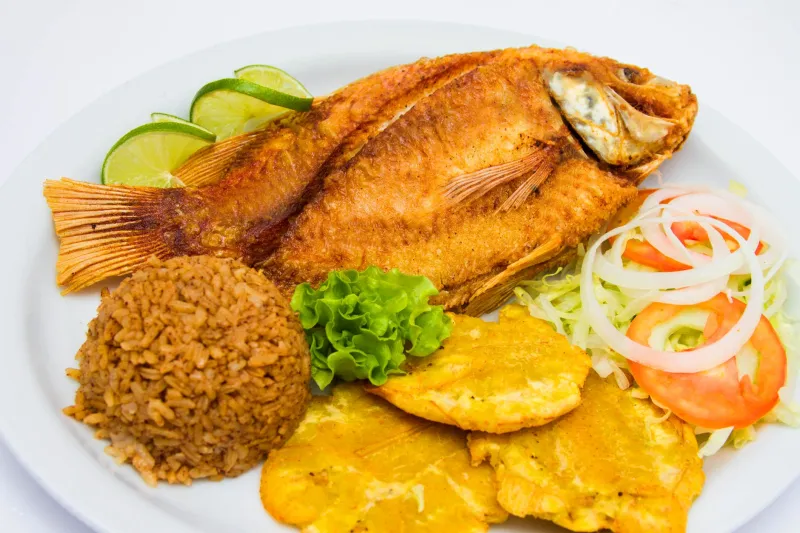
If hojaldres are Panama's morning ritual, tostones are the all-day, every-day snack and side dish that shows up at every table, every occasion, every time someone wants something salty and satisfying. You might know them by another name — patacones is common in parts of Latin America — but the technique is the same: green plantains, fried twice.
The double-fry is the non-negotiable part. First fry flattens and partially cooks the plantain. Second fry crisps it up into something with real structural integrity — a chip you can dip, a platform you can load with toppings, a snack that disappears from the bowl faster than you expect.
For tostones:
Use green plantains. Not yellow, not spotted — green. The greener, the starchier, which is exactly what you want for the right texture. Peel them (a knife works better than your fingers at this stage), slice them into 1-inch rounds, and fry in oil at around 325°F for 3 to 4 minutes, just until they're softened and lightly colored.
Remove them, drain briefly, and flatten each piece to about ¼-inch thickness. You can use a tostonera — a dedicated wooden press sold at most Latin grocery stores — or just press them flat with the bottom of a heavy glass. Back into the oil they go, this time at 375°F, for another 2 to 3 minutes until deeply golden and crisp.
Salt them immediately. In Panama, they're often served with a garlic sauce — ajo blanco, basically olive oil blended with roasted garlic — or just a squeeze of lime. For weeknight purposes, they're an excellent side dish for anything from grilled chicken to black beans and rice.
Why These Recipes Belong in American Kitchens
Here's what makes Panamanian fried food different from the fried food most Americans are used to: it's not trying to be indulgent. It's not dripping with batter or engineered for maximum excess. These are everyday foods that happen to involve a frying pan. They're affordable, fast, and made from ingredients available at any grocery store or Latin market.
Tostones in particular are a revelation for people who think they don't like plantains. The starchy, neutral quality of green plantains means they take on whatever flavors you put with them — they're a blank canvas in a way that sweet ripe plantains (maduros) aren't. And hojaldres are the kind of bread that makes people ask "wait, you made this?" with genuine disbelief, because they look more impressive than the effort involved.
The Cultural Weight of a Simple Recipe
In Panamanian households, these foods carry a lot of memory. Hojaldres on a Saturday morning mean someone got up early to make breakfast. Tostones at a party mean there's a person standing at the stove, frying in batches, making sure the bowl never empties. These aren't fancy dishes — they're love languages expressed through hot oil and simple dough.
Bringing them into your own kitchen doesn't require any special equipment or hard-to-find ingredients. It just requires a willingness to stand at the stove for twenty minutes and trust that something straightforward can also be something really, genuinely good.
Start with the hojaldres this weekend. Make them for breakfast with some scrambled eggs and hot sauce. Then try the tostones on a weeknight alongside whatever protein you've already got planned. You'll understand pretty quickly why Panamanian families have been making these for generations — and why they're not going anywhere.