Every Bite Has a Birthday: The Holiday Foods That Define the Panamanian Calendar
There's a saying that gets passed around Panamanian kitchens during the holidays — something along the lines of si no hay comida, no hay fiesta. If there's no food, there's no party. And while that logic probably holds in most cultures, Panama takes it to another level entirely. Here, the food is the celebration. It carries the history. It connects the generations. It tells you exactly where you are in the year.
For Panamanians living in the US, the holiday table becomes something even more loaded — a way to hold onto home when home is a few thousand miles away. And for Americans discovering Panamanian cuisine for the first time, these dishes offer a window into a culture that's as layered and fascinating as any in the hemisphere.
Let's walk through the year, one dish at a time.
December's Crown Jewel: The Tamal Panameño
If you grew up in a Panamanian household, December smells like corn masa, achiote, and the steam rising off a pot that's been going since early morning. The tamal panameño is the undisputed centerpiece of Christmas and New Year's celebrations — and it's nothing like the Mexican tamale most Americans know.
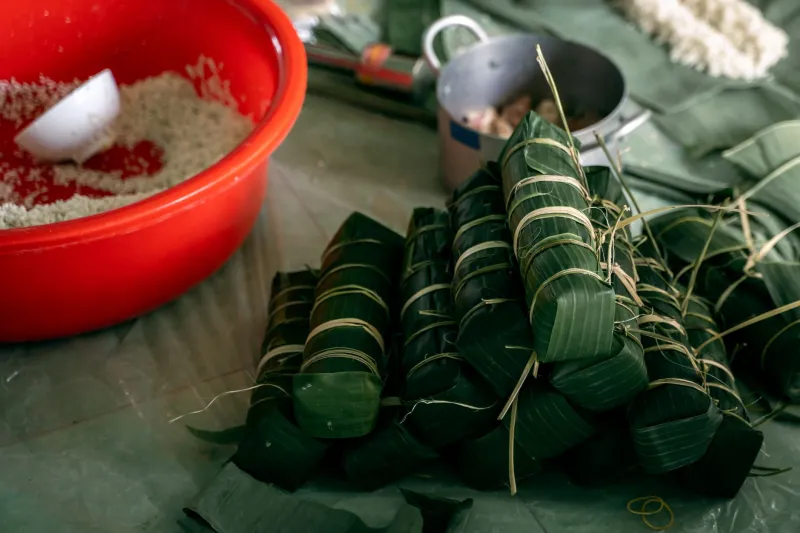
Panamanian tamales are bigger, wetter, and wrapped in banana leaves instead of corn husks. The masa is softer, almost porridge-like, and packed with a filling of chicken or pork, olives, capers, raisins, and roasted peppers. That combination — savory meat with a hint of brine and a whisper of sweetness — is pure Panama. It's the same flavor profile that shows up across the cuisine: never one-dimensional, always a little surprising.
Making tamales is a full-family production. The women (and increasingly, the men) gather to spread masa, layer filling, fold the banana leaves just so, and tie each bundle with strips of the same leaf. Then everything goes into a massive pot to steam for hours. The process is slow, communal, and completely intentional. You don't rush tamales. You make tamales.
Regional variations exist across the country. In the Azuero Peninsula — Panama's folkloric heartland — tamales tend to be spicier and more richly seasoned. In the city, you might find versions with more olives or a heavier hand with the achiote. But the soul of the dish stays the same wherever you go.
Carnival and the Seafood That Feeds a Nation
Panama's Carnival is one of the biggest in Latin America, and it lands in February or March — right in the middle of the dry season, when the coast is at its most generous. Four days of music, dancing, water fights, and culecos (massive street parties with water trucks) demand food that's festive, shareable, and deeply tied to the land.
Seafood rules Carnival in Panama. Ceviche shows up everywhere — little cups of fresh corvina or shrimp marinated in citrus, tossed with onions, cilantro, and a kick of ají chombo (Panama's beloved scotch bonnet pepper). It's cold, bright, and absolutely perfect for eating on your feet in the middle of a crowd.
But Carnival also brings out carimañolas — deep-fried yuca dough stuffed with seasoned ground beef or cheese — and patacones piled high with whatever's fresh from the market. These are street foods at their finest: portable, satisfying, and made to be eaten while the music is already playing.
For Panamanians in the US who can't make it to the festivities, recreating a Carnival spread at home is one of the most effective ways to bring that energy into a stateside kitchen. Set out the ceviche, fry up a batch of carimañolas, put on some típico music, and suddenly the living room has a different atmosphere entirely.
Semana Santa: When the Sea Takes Center Stage
Holy Week in Panama is serious business — and so is the food that comes with it. The Catholic tradition of abstaining from meat during Semana Santa means seafood becomes the star of the table for a full week, and Panamanian cooks rise to the occasion beautifully.
Guacho de mariscos is the dish that defines this period for many families. It's a thick, soupy rice stew loaded with shrimp, clams, squid, and whatever else the fishmonger had that morning. The base is built on sofrito — that essential combination of onion, garlic, ají amarillo, and culantro — and the whole thing simmers until the rice has absorbed every bit of flavor the seafood has to offer. It's rich without being heavy, and deeply, unmistakably Panamanian.
Fried fish with patacones and arroz con coco (coconut rice, a staple on the Caribbean coast) also makes regular appearances during this week. The coconut rice, in particular, carries the influence of Panama's Afro-Caribbean communities — a reminder that the country's food is a living archive of its diverse heritage.
November: Independence, Pride, and a Table Full of Classics
Panama celebrates multiple independence days in November — from Colombia on November 3rd, and from Spain on November 28th — and the month becomes a sustained expression of national pride. Food plays a central role in that identity.
The dishes that appear on Panamanian tables during November aren't flashy or complicated. They're the classics: ropa vieja with white rice and guandú (pigeon peas), sopa de pata (a slow-cooked cow's foot soup that's more delicious than it sounds), and arroz con pollo made the way abuela makes it — with plenty of vegetables, a good amount of sazón, and enough to feed everyone who shows up unannounced.
These are comfort foods in the truest sense. They don't need to be reinvented or elevated. They just need to be made with care.
Bringing It All to Your Table
For American home cooks who want to explore Panamanian holiday food, the entry point doesn't have to be intimidating. Start with a batch of ceviche for your next gathering — the technique is simple and the results are genuinely impressive. Work your way up to a pot of guacho on a Sunday afternoon. And when December rolls around, consider making tamales a new family tradition.
The ingredients you need are more accessible than ever. Latin grocery stores across the US carry achiote paste, culantro, ají chombo, and banana leaves. Online retailers have filled in the gaps for harder-to-find items. The barrier to cooking authentic Panamanian holiday food in an American kitchen has never been lower.
What these dishes ask of you isn't expertise. It's time, attention, and a willingness to let the process be part of the celebration. In Panama, the hours spent cooking before a holiday are as meaningful as the meal itself. The kitchen is where the stories get told, where the techniques get passed down, and where the culture stays alive.
That's worth recreating, no matter which side of the equator you're on.