Every Panamanian Family Has a Rice Argument — Here's Why That's the Whole Point
Ask a Panamanian home cook how they make their rice and you'll get an answer that sounds less like a recipe and more like a personal manifesto. The water ratio is non-negotiable. The moment you lift the lid — or refuse to — is a matter of principle. Whether you toast the grains first, how much achiote goes in, and exactly when you add the chicken are decisions that have ended kitchen debates and started new ones across generations.
Rice in Panama isn't background. It's the whole conversation.
More Than a Staple — A Cultural Anchor
In most American kitchens, rice plays a supporting role. It shows up under something else, soaks up a sauce, fills out a bowl. In Panamanian cooking, that logic is flipped. The rice is the dish. Arroz con pollo, arroz con guandú, arroz con mariscos — these aren't proteins with rice on the side. They're unified, slow-built meals where the grain absorbs everything: the fat, the sofrito, the steam, the seasoning, the time.
"My grandmother would say the rice has to taste like something before anything else touches it," says Marisol, a Panamanian-American home cook based in Miami who learned to cook from her abuela in Chiriquí province. "She'd season the oil, toast the rice in it, then build from there. If the rice was bland, the whole pot was a failure no matter what else you put in."
That philosophy — that the rice itself carries flavor, not just absorbs it — is one of the foundational ideas in Panamanian home cooking. And it's also the source of a lot of very heated family opinions.
The Arroz con Pollo Debate Is Very Real
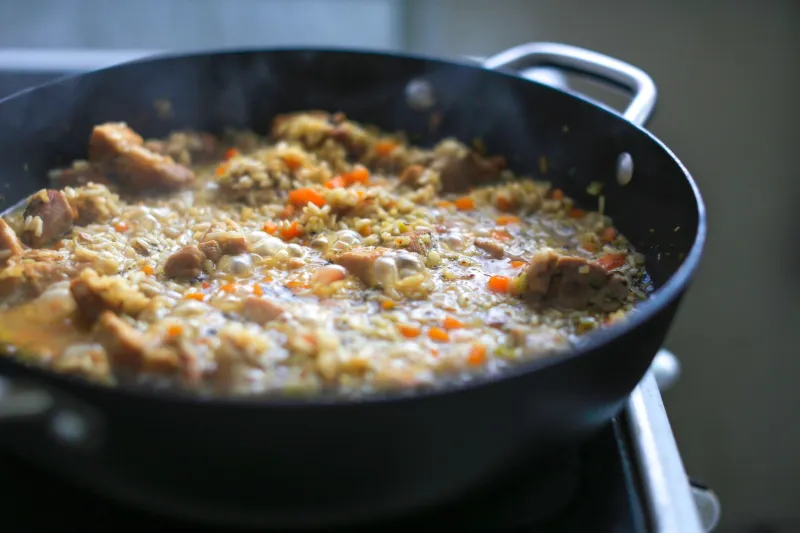
If there's one dish that crystallizes the rice argument in Panamanian households, it's arroz con pollo. On paper, the concept is simple: chicken, rice, vegetables, seasoning, cooked together in one pot. In practice, it's a dish that varies wildly from household to household — and every cook believes their version is the correct one.
Do you brown the chicken first or cook it directly in the rice? Do you use a whole bird or just thighs? Is the color supposed to come from achiote, tomato paste, sazón, or some combination of all three? Does it need olives? Capers? Raisins? (Yes, raisins — and yes, people have strong feelings about this.)
"My mom's arroz con pollo has raisins and capers," says Carlos, who grew up in Panama City and now lives in Houston. "My wife's family is from Colón and they think that's insane. We've been married twelve years and we still haven't settled it. We just make both versions at Christmas."
This isn't dysfunction. This is Panamanian food culture working exactly as intended — dishes that are personal enough to argue about, and communal enough to share anyway.
Rice and Beans: The Dish That Changes by Province
If arroz con pollo is the flashpoint, arroz con guandú — rice cooked with pigeon peas, usually finished with coconut milk — is the dish that quietly reveals where someone is from.
On the Caribbean coast and in Afro-Panamanian communities, coconut milk is non-negotiable. The rice comes out creamy, slightly sweet, with a richness that turns a simple pot into something you want to eat on its own. In other parts of the country, the coconut gets dialed back or dropped entirely, and the flavor profile shifts toward something earthier and more savory.
Then there's the question of the guandú itself — fresh versus dried versus canned, soaked overnight versus cooked straight from the bag. Each choice changes the texture of the final dish and, apparently, reveals a lot about the cook's background and patience level.
"Canned guandú is a shortcut," says Lucinda, a food writer of Panamanian descent based in New York. "I use it on weeknights and I feel mildly guilty every time. My aunt would not approve."
The Technique Nobody Writes Down
Here's the thing about Panamanian rice dishes that makes them hard to replicate from a recipe alone: the most important parts are almost never written down. They live in muscle memory, in the sound of the pot, in the way steam escapes when the lid is lifted at exactly the wrong moment.
Panamanian cooks talk about feeling when the rice is ready — not just checking a timer. They describe the sound the pot makes when the water is almost absorbed, the way the grains look when they've gone from translucent to opaque, the faint smell that signals you're about thirty seconds away from the bottom catching.
That bottom layer, by the way, is not a mistake. The slightly crispy crust that forms on the bottom of the pot — called pegao in many Latin American kitchens — is actively sought after in Panamanian households. It's the reward for patience, the cook's tax on the meal, and the thing everyone fights over when the pot hits the table.
"The pegao is the whole reason to make rice in a pot instead of a rice cooker," Marisol says. "My kids know not to touch it before I do."
How to Get There From Your American Kitchen
If you're working with a standard American stovetop and a pot that isn't your grandmother's well-seasoned caldero, a few adjustments go a long way.
Start by toasting your dry rice in a thin layer of oil — annatto oil if you can find it, or neutral oil with a pinch of achiote powder — before adding any liquid. Stir constantly for about two minutes until the grains smell nutty and look slightly golden. This step alone changes the texture of the finished rice and builds flavor from the very beginning.
Build your sofrito base directly in the same pot before the rice goes in. Onion, garlic, culantro or cilantro, bell pepper, and tomato, cooked down until soft and fragrant. Add your rice to this base, coat it in the aromatics, then add your liquid — chicken broth over water, always — at roughly a 1:1.5 ratio for most Panamanian-style rice dishes.
Once the liquid is absorbed and the rice is nearly done, drop the heat as low as it will go, cover the pot tightly, and leave it alone for ten minutes. No peeking. The steam does the work. That final rest is where the texture comes together and, if you're lucky, where the pegao forms.
Why the Argument Is Worth Having
The debates around Panamanian rice dishes — raisins or no raisins, coconut or no coconut, canned beans or dried — aren't really about rice. They're about identity, memory, and the specific way food carries culture across generations and across borders.
For Panamanian-American families navigating life far from home, a pot of arroz con guandú or arroz con pollo isn't just dinner. It's a declaration. It says: this is where we're from, this is how we do it, and we will absolutely argue about it at the table because that's part of how it's supposed to feel.
The rice brings everyone together. The argument is just the seasoning.